Bees and other pollinators are essential for productive gardens. The right bee house provides safe nesting sites, supports pollinator populations, and enhances biodiversity without chemical interventions. Below we highlight five top bee houses that suit American gardens, focusing on durability, accessibility, and how they encourage healthy pollination across vegetables, fruits, and flowers.
| Product | Brand | Key Benefit | Link |
|---|---|---|---|
| Nature’s Way PWH1-C Teal Bee House | Nature’s Way | Attracts solitary bees for up to 20x honeybee pollination | View |
| Nature’s Way PWH1-B Purple Bee House | Nature’s Way | Supports diverse solitary pollinators and biodiversity | View |
| Lulu Home Wooden Insect House | Lulu Home | Multi-habitat attractor for bees, butterflies, ladybugs | View |
| POLLIBEE Mason Bee House Wax Coated | POLLIBEE | Wax-coated, weatherproof, ready-to-hang mason bee habitat | View |
| WILDLIFE FRIEND Insect Hotel | WILDLIFE FRIEND | Weatherproof year-round shelter for bees, ladybirds, butterflies | View |
The following sections profile each product with essential features and how they support garden health. All choices emphasize durable materials, varied nesting options, and ease of installation for American gardens.
Nature’s Way PWH1-C Teal Bee House

The teal bee house from Nature’s Way is designed to attract gentle solitary bees that can dramatically increase pollination in home gardens. Its construction focuses on attracting pollinators without requiring complex setup, making it suitable for beginners and seasoned gardeners alike. The design supports easy mounting, enabling quick placement on a fence, garden wall, or post.
Key features include the ability to attract pollinators capable of up to 20x the pollination of honeybees and a simple hanging mount for convenient installation. Its emphasis on attracting beneficial insects aligns with sustainable garden practices and reduced pesticide reliance.
Nature’s Way PWH1-B Purple Bee House

This purple-bee version offers the same core benefits as the teal model, with an emphasis on attracting a diversity of solitary bees that contribute to robust pollination. The bamboo tubes and natural materials provide varied nesting opportunities, helping to increase local pollinator diversity. The product supports sustainable gardening by promoting healthy plant growth through enhanced pollination rates.
Designed for durability and easy hanging, this bee house is well-suited for patios, balconies, or garden borders where pollinator activity can be encouraged throughout the growing season.
Lulu Home Wooden Insect House

This insect hotel from Lulu Home offers multiple compartments filled with natural materials like bamboo tubes and pine cones, tailored to attract mason bees, solitary bees, butterflies, ladybugs, and lacewings. The weather-resistant wood and dual mounting options (stake or hanging) provide flexible placement across garden beds, porches, or tree trunks. A well-rounded habitat supports both pollination and natural pest control.
POLLIBEE Mason Bee House Wax Coated
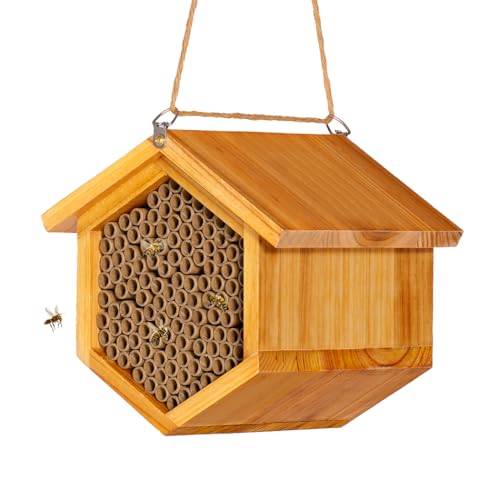
This wax-coated mason bee house by POLLIBEE focuses on durability and long service life. The full-body wax coating helps protect against rain and weather, extending the nesting habitat’s lifespan. The product arrives assembled with a stainless steel screw clasp, enabling straightforward wall or tree mounting. It’s designed to attract mason bees and support pollination in gardens and orchards, potentially boosting fruit and vegetable yields.
WILDLIFE FRIEND Insect Hotel

The Wildlife Friend insect hotel emphasizes year-round shelter with a rain-resistant metal-roof design. Built from solid wood, it provides a durable habitat for bees, ladybirds, and butterflies, supporting biodiversity and ecological balance. The structure is suitable for garden borders, patios, or under tree canopies where beneficial insects can overwinter and breed, contributing to a healthier garden ecosystem.
Buying Guide: Key Considerations For Choosing A Bee House
- Material and weather resistance: Look for cedar, pine, or other durable woods, and water-resistant coatings to withstand rain and sun without harming pollinators.
- Entrance design and tube variety: A mix of tube diameters supports multiple solitary bee species, increasing pollination diversity.
- Size and mounting options: Choose a size that fits your space and provides easy mounting on fences, walls, or garden posts.
- Ease of maintenance: Some units arrive ready-to-hang; others may require simple cleaning between seasons to ensure health and longevity.
- Pollinator diversity: Favor products that attract bees, butterflies, and other beneficial insects to maximize garden health and pest control.
- Environmental impact: Eco-friendly materials and sustainable production practices contribute to long-term garden stewardship.
When selecting a bee house, consider your local climate, garden size, and the target pollinators. A well-placed, sturdy habitat can boost pollination, support beneficial insect populations, and contribute to a resilient garden ecosystem across seasons.